


Recent developments in climate law have prompted a review on legal guidance by the Law Society of New South Wales (NSW), which highlights the growing responsibility on solicitors to advise clients of climate-related risks. Some of the physical risks of climate change include changing weather patterns, the increasing threat of extended periods of drought, fire, flooding, coastal erosion and other natural disasters. This means that property and real estate is at risk – buyers will need to aspect climate risks into their purchase decisions – not only what’s occurring in the present, but also future risks to safeguard their long-term value.
Climate change – refreshed guidance in 2025
In August 2025, the Law Society of NSW imposed extra guidance for solicitors and conveyancers that additional due diligence should be considered – where physical risks have been identified. Their updated Guidance Practice Note 3.4(1) states that additional due diligence regarding possible physical risks, may include obtaining a report or reports from specialist commercial search providers which identify climate factors and other environmental risks affecting a property. This follows on from updates and guidance issued by Australia’s National Climate Risk Assessment and National Adaptation Plan*.
Jenifer Bell, President of the Law Society of NSW said: “A new section on all real property transactions could affect the many solicitors who undertake conveyancing work and the home buyers or sellers whom they advise. Climate related issues involved in real property transactions can include advising on bushfires or flood risks and the affordability, or even the availability of insurance, which could affect the ability to obtain mortgage finance.”
Rising risk factors – what you need to know
The Australian National Climate Risk Assessment’s first pass assessment(2) states that the number of coastal communities (at SA2 level) exposed to high or very high risk from coastal hazards will go from 8% in 2030 – to 18% in 2050, and increase to 34% in 2090. If coastal community populations remained as they are today, it equates to 1.5 million Australians living in areas that will experience sea level rise and coastal flooding by 2050. Homes situated in (defined) high risk areas will continue to rise – for example, in Queensland, 175,000 homes are considered ‘high risk’ under a 1.5°C warming scenario – rising to 185,000, under a 3°C warming scenario.
There is also a serious projected loss of property values – by 2050, property values may lose up to A$611 billion in value due to climate-related risks. And, by 2090, losses could rise to approx. A$770 billion – under a 3°C warming scenario.
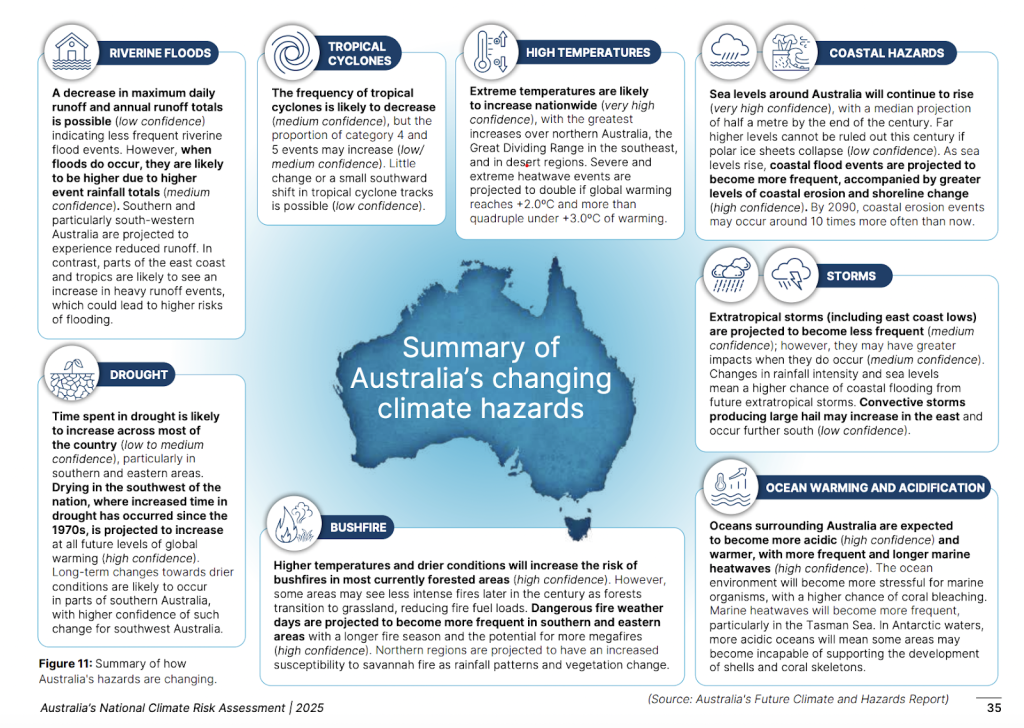
Below: Australia’s first National Climate Risk Assessment – a summary of changing climate hazards, including flooding, bushfires and storms – published by the Australian Climate Service(3)
There will be some serious risk factors and implications to consider for property transactions –
- Risk disclosure and due diligence: Buyers of residential and commercial properties will need to consider these climate risks when making purchasing decisions.
- Stranded assets: Future implications to property transactions include: high-risk properties may lose significant value, or even become unmarketable
- Property market demands shifts: The market demand will shift – whereby buyers might favour ‘safer’ areas, which will alter the demand and property values
- Insurance costs soar: Rising insurance premiums and uninsurability will impact mortgages and their appeal and access. Some properties are expected to become uninsurable in the future – affecting affordability and lending
- Valuation adjustments: Present and future climate risks may be priced into appraisals – reducing the value in high-risk areas
- Regulatory impact: An increase in strict and rigorous building codes and new adaptation requirements may add further costs to the property transaction.
- Risk differentials: Risks may escalate sharply (i.e. greater losses in value and insurance challenges) – due to higher climate warming scenarios (although some of the climate impacts are already locked in).
Refreshed legal guidance: what is means for conveyancer and lawyers
All conveyancers and property lawyers should now fulfil their key duties and responsibilities with the Law Society of NSW Climate Change Practitioner Guidance. Currently, the Australian government provides macro-level national assessments, however, buyers, lenders and legal professionals additionally need property-specific information.
As a land and property professional, you’ll need the practical links between national adaptation planning and the everyday property transactions. Groundsure supports legal experts – from lawyers, conveyancers, valuers and lenders, with transaction-ready risk reports. Our reports translate climate data into actionable insights – at an individual property level.
Groundsure – the ideal partnership for complete property risk due diligence
You can now act quickly to identify current and future climate risks at a property-specific level with the Groundsure’s ClimateIndexTM report. It helps buyers and lenders understand whether a property has a property-specific environmental risk. Our report highlights when a property is in a high-risk area and will subsequently face value loss or stranded asset risk. ClimateIndexTM is the first desktop report on current and future climate risks to identify potential impacts on financing, insurance and the transactional process of NSW land and property. Our certification section helps to support insurability and lending decisions – with insurance affordability and availability flagged as critical risks. This opens opportunities to proactively engage with banks and insurers as a portfolio risk management tool.
Groundsure is not just a risk-assessor, we help future-proof your client’s property decisions. Our ClimateIndexTM report provides next steps guidance – to help buyers safeguard long-term value.
Key benefits to you:
- Supports your duty of care in advising your client on climate change risks during the property transaction
- Provides an unrivalled approach: by combining trusted sources with unique, proprietary data modelling
- Identifies potential issues with insurance or mortgage availability
Key features:
- Identifies three key physical risks: flooding, bushfires and coastal erosion
- Provides current, 5-year and 30-year forward risk predictions
- Provides next steps guidance, specific to each identified risk. Full colour mapping.
The ClimateIndexTM Report is available to order now – via InfoTrack, Australia.
For more information visit groundsure.com/au Or, email us at: [email protected]
(*) Read the National Adaptation Plan here
(1) Read the updated Climate Change Practitioner Guidance here.
(2)See the full Climate Risk Assessment here. (3)PDF summary of the climate risk assessment report here.